Tasmanian Family History Society Hobart header

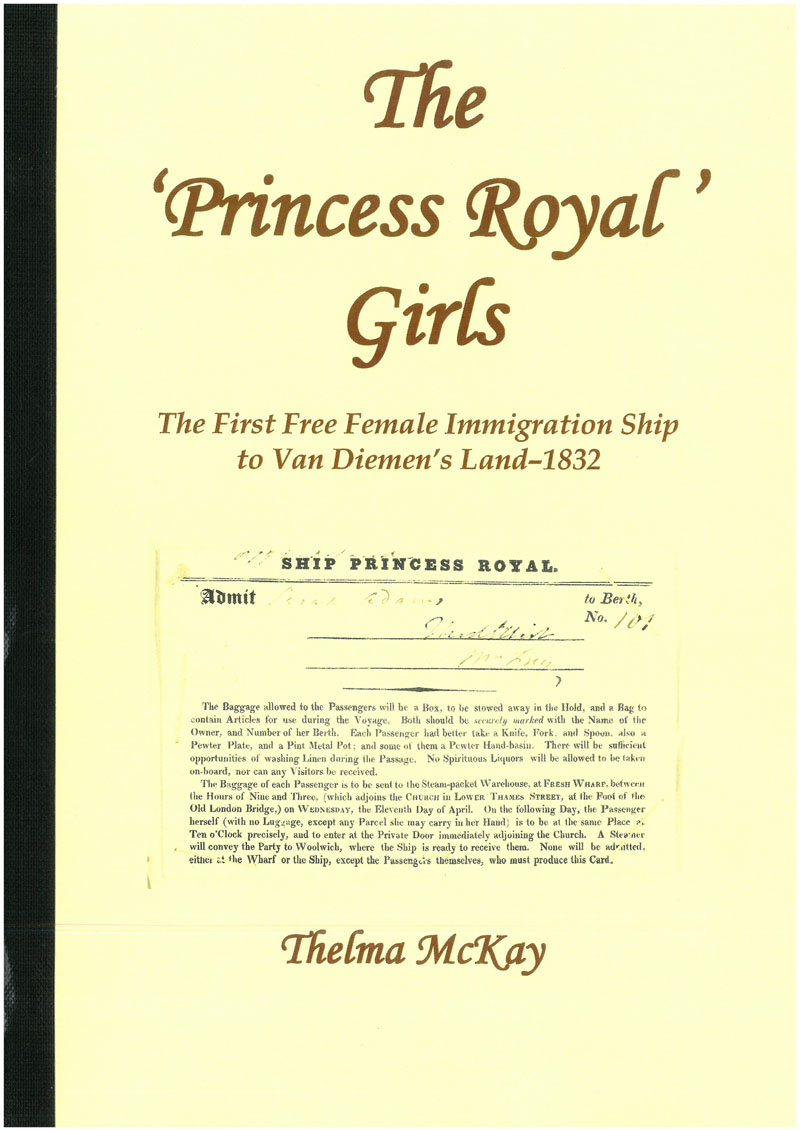
The 'Princess Royal' Girls
The First Free Immigration Ship to Van Diemen's Land - 1832

Publication No. 18   Size: A4   Weight: 650 grams
18A    18C

Researching the 200 girls who arrived in Hobart Town as free emigrants on the Princess Royal in 1832 has been a very challenging, but interesting project. Whilst researching our ancestor, Catherine Hand, many years ago and finding she came from the School of Reform in Chelsea, I wondered if by chance she had kept in touch with Hannah Substead, the only other girl from the same school. Hannah married in 1838 and left VDL in 1843 for NSW, no other references has been found after this period to confirm any contact between these girls. Over half of these emigrants came from institutions, which the government were not expecting, and therefore thought were anything but a benefit to the colony. It is hoped that by compiling the profiles of these free emigrants, that most of those considered 'bad' by the authorities, did in fact lead a respectable life. Many left in the early period for NSW, also to the new colony of Port Phillip in Victoria. Others moved with their husbands to South Australia and even Western Australia, making the task of verifying if indeed they were a Princess Royal girl, even harder.

This ship, the Princess Royal, was the first of several more ships to follow bringing out free female emigrants, but after the manner in which these first girls were chosen, mostly from institutions and workhouses, the Commissioners for Emigration, who had helped with the selection, were disbanded and the London Emigration Committee was formed.

Four entry lists have been consulted to compile the names of the emigrants. The alphabetical list sent from England by William Fry is the most complete and has the added advantage of including their ages, whether they had been in one of the institutions or regarded as 'respectable'. It also gives their cabin number and comments made on their arrival in Hobart Town by the Ladies Committee. Nine children, who are not named, are also included. Other lists were made by the Customs and Port Officers' in Hobart Town which both have at least two girls missing and younger girls and children, that accompanied their mothers, are not named. The Marine Board entry contains only eighty-one names, and it appears that the second part of this document is missing. Unfortunately no listing has been found regarding to whom the girls were employed on arrival.

Forty-three girls came from the London Female Penitentiary at Pentonville, twenty-two were taken from the workhouses in London, with another thirty-five from the National Guardian Servants Institution. Many girls were noted as 'very respectable', or had left their former place of employment to emigrate. Several more came out to join members of their family already here in Van Diemen's Land. The brothers of both Elizabeth Haggar and Jane Christmas had been transported earlier, in 1828 and 1831 respectively. The Wiggins sisters joined their brother, William Hayne Wiggins, who later married a Princess Royal girl, Jane Mears. Jane Barker was about to be married in England when her husband to be, John Bromley, was convicted of stealing and transported to Hobart Town. Jane, who was pregnant when he left, came to join John bringing their son with her. Three families also came out where the husband in each case worked his passage as part of the crew, and two widows not only brought their young daughters, but their sons, who also were listed as crew members. Many relatives came out later from England to join their families in Tasmania.

The local newspapers first wrote articles on the arrival of these 'ladies', they later changed their opinion naming them 'females', and then finding some were charged before the police courts for being drunk, noting them as the 'Princess Royals' or 'Royals'. These names, regarding the Princess Royal girls, were still implied several months after their arrival. Only a small number of girls went out 'on the town' in the first couple of weeks after their arrival and were charged for drunkenness. One girl, Ann Dallen who was charged several times, had been a brewer of beer in England where her father was a maltster, perhaps she was just sampling the brew to compare it with back home? After all, they had survived almost being shipwrecked in a gale on the approach Jo Hobart Town, the ship finally running aground in Frederick Henry Bay where they had to camp for six days before being taken up to Hobart Town, its no wonder some of them wanted to celebrate on finally arriving at their destination.

One girl, Mary Glover, died on the voyage, one was murdered four years after her arrival, and three are known to have been convicted of crimes, therefore entering into the convict system.

©TFHS Inc. All rights reserved
Site last updated February 2026